
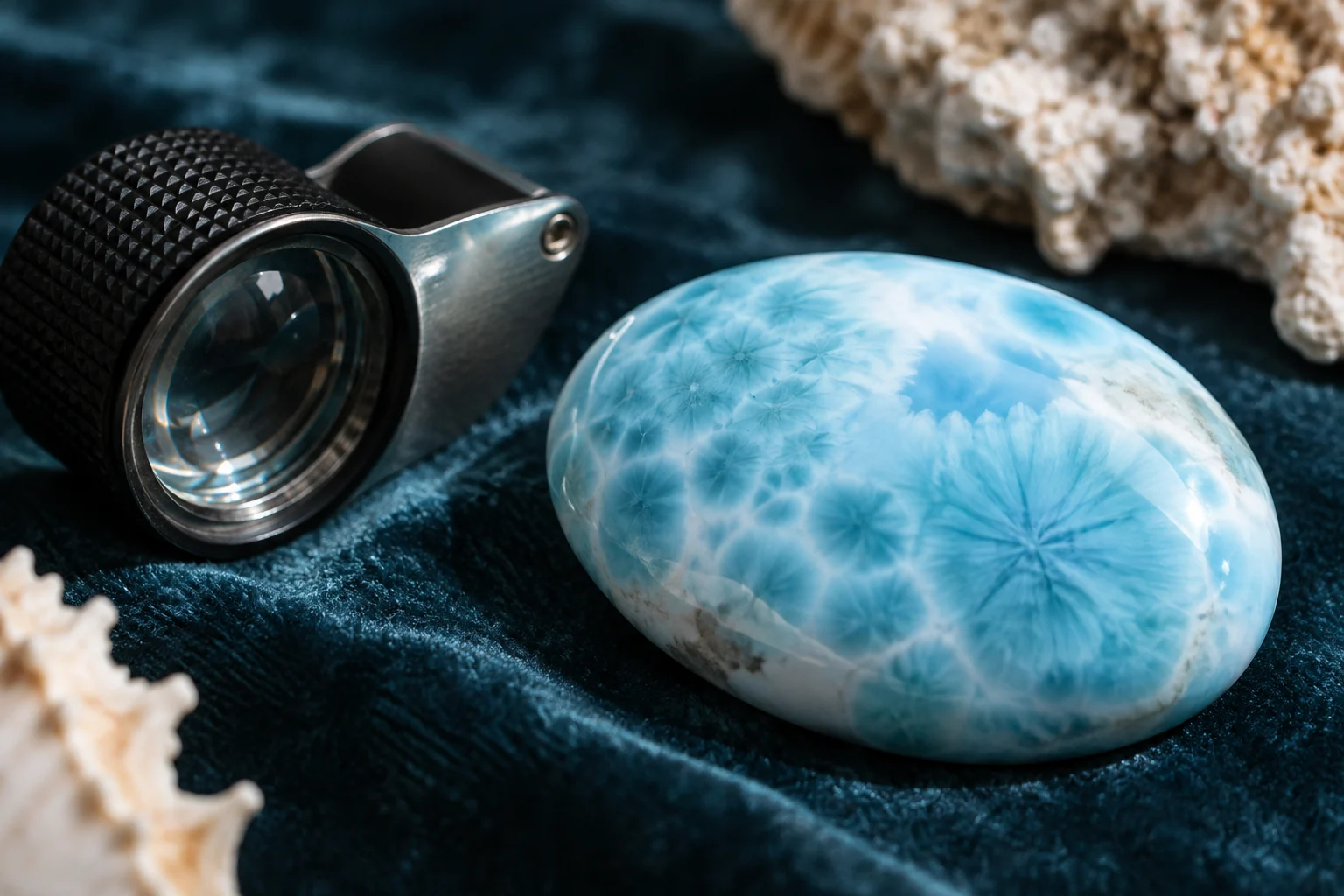
The key point
A photograph, blue-and-white pattern, or single home test cannot conclusively prove Larimar’s identity. Start with a clear seller disclosure, match the exact item to its records, and use an independent gemologist when the identity or treatment claim matters to the purchase.
First establish what the seller is claiming
Ask for a plain material description. “Natural Dominican blue pectolite” is a different statement from “Larimar-like,” “reconstituted,” or “blue gemstone.” Record treatment and construction disclosures separately. If a seller uses a term you do not understand, ask for its meaning before comparing the item with natural stone.
Preserve the complete listing, exact item ID, photographs, measurements, and written answers. This creates a link between the claim and the object. A general certificate for a supplier, a report on a sample, or a picture of a different stone does not automatically document the piece you receive.
Imitations are documented, not merely hypothetical
GIA published a case involving a ceramic cabochon resembling Larimar. Microscopy and gemological measurements distinguished that sample from pectolite. The lesson is limited but important: a visually convincing appearance can be produced by a different material, and appropriate examination can resolve that case.
This case study does not establish how common ceramic imitations are, nor does it prove that a listing from a particular country is suspect. Judge the material and evidence, not a stereotype about a seller’s location. An imitation offered with clear disclosure is a different proposition from one misrepresented as natural Larimar.
Reference context: Kiefert & Groenenboom, Imitation Larimar (GIA, 2013)
What professional testing contributes
An examiner can select suitable observations and measurements for the object. In the GIA case, microscopy, refractive index, and specific gravity helped distinguish the material. The relevance of a technique depends on factors such as polish, shape, size, mounting, and the specific question being asked.
An identification report is not a guarantee of investment value, sourcing conditions, or every statement in a sales description. Ask what the report concludes, what was not determined, and whether mounting limited the examination. Identity, treatment detection, origin opinion, and appraisal should remain separate questions.
Reference context: Kiefert & Groenenboom, Imitation Larimar (GIA, 2013)
Why reference numbers are not a home-test recipe
A mineral handbook gives properties for pectolite, but applying them requires an appropriate method. Weighing a stone alone does not establish density; a photograph does not measure refractive index; an uncertain scratch result does not identify a mixed or treated specimen. A plausible number from an unsuitable method can be misleading.
Avoid destructive experiments. Scratching glass or a stone, heating it, applying acid, or trying a solvent can damage material and make a return or later examination more complicated. A cold feel, flashlight appearance, or reaction to a brief contact with water is not a conclusive identity test either.
Reference context: Handbook of Mineralogy: Pectolite
Visual inspection is still useful—with the right purpose
Images can document condition, shape, finish, and construction. Request the front, back, edge, and a short video in neutral light. For jewelry, include the underside and mounting. For rough, distinguish wet from dry views. Compare visible features with the item delivered.
Use these observations to ask better questions rather than pronounce an identity. An apparent bubble, line, or color concentration in a low-resolution photograph may need magnified examination. Equally, an appealing natural-looking pattern is not proof that all treatments or assembled construction have been excluded.
Observe first. Verify separately.
- 1Pattern
Record the visible pattern.
- 2Edge
Inspect edges for chips and wear.
- 3Profile
Request a side view and dimensions.
- 4Back
Ask for an unobstructed back view.
| Check | Useful for | Limit |
|---|---|---|
| Exact-piece photographs | Appearance, condition, item matching | Cannot conclusively identify material |
| Seller’s written disclosure | Defining the claim before purchase | Not independent testing |
| Report number verification | Checking issuer records and item details | Scope still needs to be read |
| Qualified gemological examination | Addressing defined identity questions | Does not automatically establish value or sourcing |
A five-stage verification workflow
Stage one: obtain an unambiguous identity and disclosure statement. Stage two: match it to exact-piece images and measurements. Stage three: inspect the scope and issuer of any report. Stage four: decide whether independent examination is needed before purchase. Stage five: agree the response if the result differs from the description.
For a higher-value commission, discuss testing before the stone is set. For wholesale, clarify whether testing covers specific pieces or a sampling plan; examination of one specimen should not be described as identification of every item in a lot. Record how sample selection was made.
What to do if a delivered stone concerns you
Keep packaging, purchase records, and photographs of the arrival condition. Compare the item with the agreed description and contact the seller within the applicable inspection period. State the observed issue precisely: an unmatched report number, different dimensions, undisclosed construction, or an unresolved identity question.
Do not alter a disputed piece before arranging a resolution or examination. An independent gemologist can help define what is testable and what remains uncertain. Keep the conclusion with the exact item record so a later owner does not receive a more confident story than the evidence supports.
Evidence worth more than a guarantee badge
The strongest purchase record is specific: the described item, transparent disclosure, an appropriate report where needed, and clear commercial terms. A badge saying authentic, a dramatic origin story, or a certificate logo without scope adds little by itself.
This guide does not identify a stone from a photograph or certify future stock on Larimar Origin. Any commercial claim must be tied to the actual item and the evidence available for it. The report-reading and treatment guides below explain those distinctions further.
Questions answered
Can I identify Larimar by its pattern?
Pattern is an observation, not a conclusive identification. Similar-looking materials exist; use suitable examination for unresolved identity questions.
Does a certificate mean my stone is real?
Read who issued it, what was examined, the conclusion and limitations, and whether it matches your exact item.
Explore this question further →Should I scratch my stone to test it?
No. A scratch can damage the stone and is not a reliable standalone method for establishing the identity of a purchased piece.
Sources & scope
A documented ceramic imitation and the role of gemological testing.
Mineral-species reference; properties of a particular gem or mixed specimen can require separate assessment.
Our initial library was developed with AI assistance. Product claims require separate item-specific evidence. Read our editorial standards.