
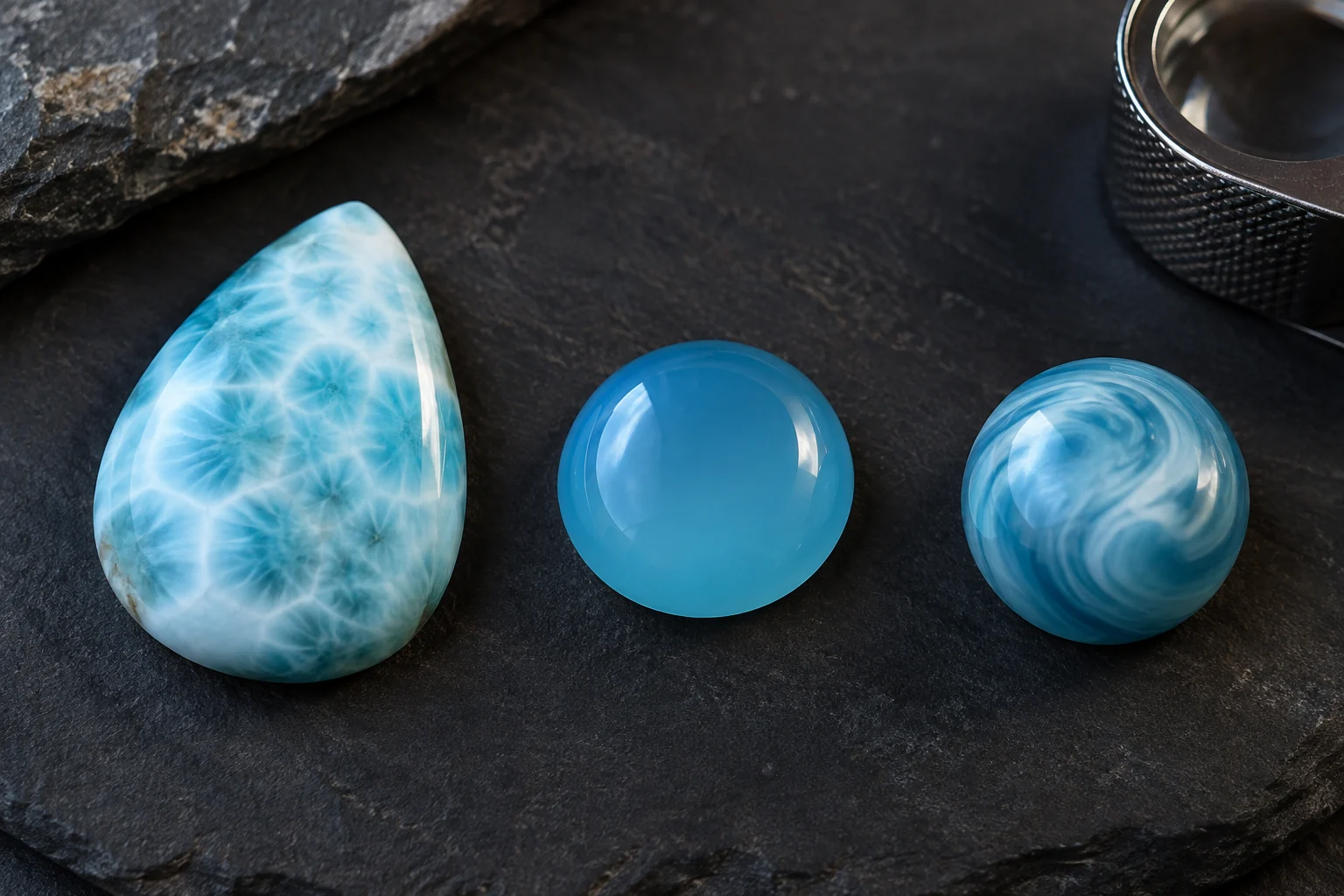
The key point
Natural origin, treatment and construction are separate disclosures. A blue-and-white pattern cannot prove Larimar identity or exclude treatment. Ask what the exact item consists of and seek suitable examination when the description remains uncertain.
Natural and untreated differ
Natural describes an origin rather than a complete history of handling. Untreated is a separate claim about modification. Ask what is known and how that knowledge was obtained. No treatment statement does not mean every possibility has been tested and excluded.
Imitations resemble another material
GIA documented a ceramic material sold as a Larimar imitation. Resemblance does not establish identity. Imitations can be sold honestly with clear descriptions; the problem is presenting them as natural Larimar or leaving buyers with that expectation.
Ask what reconstituted means
For terms such as reconstituted, composite, stabilized, or enhanced, request a description of constituents and processing. Do not infer a recipe from a label. Ask about fragments, binders, coatings, dyes, and adhesives, and implications for cleaning and repair.
Ask about construction
Confirm whether a cabochon is one piece or assembled. Side and back photographs help describe construction but are not substitutes for testing. Important disclosures belong in the product description before purchase, not hidden after checkout.
Keep disclosures
Save treatment statements, item IDs, images, and complete reports. Pass them on when gifting or reselling, so descriptions do not become less precise as an item changes hands. Avoid turning an unverified supplier statement into your own assertion of laboratory certainty.
Four descriptions that must not be collapsed into one
Separate identity, treatment and construction. A natural stone can have undergone treatment; an imitation can be a different material without being assembled; a composite can combine more than one component. “Stabilized,” “natural” and “Larimar-like” therefore do not answer the same question. Ask the seller to state the material of each component, any known treatment and whether the item is one piece or assembled. These are questions to establish what is offered, not a claim that a particular treatment is common in Larimar.
Why a convincing pattern does not settle identity
The ceramic imitation documented in Gems & Gemology shows why blue-and-white appearance alone is insufficient. A photograph can help identify an area to examine, but cannot reproduce a laboratory investigation. Do not scratch, heat, burn or apply solvent to a questioned stone as a home test. Preserve its condition, photograph the exact item and ask a qualified examiner which nondestructive observations are suitable. Keep the seller’s description separate from the examiner’s conclusion.
Reference context: Kiefert & Groenenboom, Imitation Larimar (GIA, 2013)
Sources & scope
A documented ceramic imitation and the role of gemological testing.
Our initial library was developed with AI assistance. Product claims require separate item-specific evidence. Read our editorial standards.