
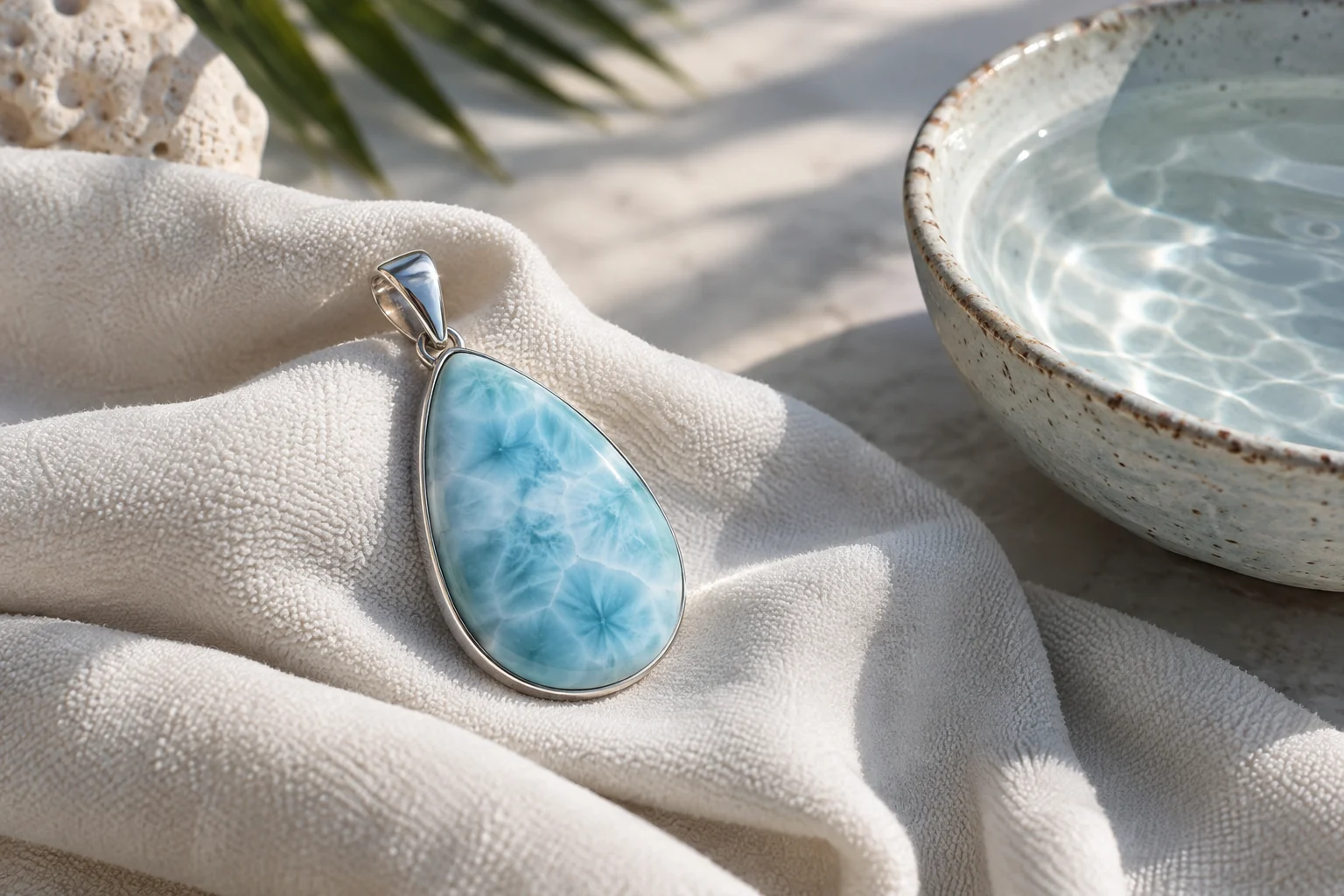
The key point
Begin routine Larimar care with a clean, soft cloth and separate storage. Before wet cleaning, check the actual stone, treatment history, and mounting with the jeweler. Avoid unapproved chemicals, abrasive home remedies, heat, steam, and ultrasonic cleaning.
Care is about the whole piece
Consider three things together: the gemstone, any modification or treatment, and the jewelry construction. A safe process for bare metal may be unsuitable for an adjacent stone or adhesive. A care label for a different gemstone is not a Larimar instruction simply because the jewelry looks similar.
The mineral reference describes pectolite’s scratch resistance separately from the behavior of compact material. In practical use, no single hardness value tells you whether a particular edge will chip, whether a setting is secure, or whether a cleaner is compatible. Use the condition and construction of your actual piece to choose a routine.
Reference context: Handbook of Mineralogy: Pectolite
A simple inspection before cleaning
Work over a clean, padded surface with good light. Look for stone movement, bent retention points, a damaged clasp, visible chips, or a new line. Compare with a previous photograph if something appears different. Do not press or pry at the stone to test whether it is secure.
If the stone moves, the mounting catches unexpectedly, or you see fresh damage, stop and arrange inspection. Cleaning cannot repair a structural problem. For an unfamiliar inherited or second-hand piece, establish what it is and how it is constructed before selecting a cleaning method.
Routine cleaning: begin gently
Use a clean, soft cloth for light dust and fingerprints. Avoid a dirty cloth that might carry grit. If this is insufficient, ask the jeweler about a method suitable for the identified stone, disclosed treatments, finish, and mounting. GIA’s general care advice emphasizes matching cleaning to the gemstone and treatment rather than assuming one method fits all jewelry.
If the jeweler approves wet cleaning, follow the specific instructions, use a controlled workspace, and keep small components away from an open drain. Dry gently. Do not interpret permission for a brief cleaning step as approval for soaking, bathing, swimming, or repeated exposure to household products.
Reference context: GIA: Tips on Caring for Jewelry
Ultrasonic, steam, and chemical cleaners
Do not use an ultrasonic machine or steam as an automatic upgrade from a cloth. GIA describes risks related to treatments and settings, including the possibility of loosening stones. The relevant question is whether the actual piece can tolerate the process, not whether the machine is sold for jewelry.
Avoid unapproved solvents, acids, bleach, and abrasive home remedies. Toothpaste, polishing powders, and a metal-cleaning product are not interchangeable with a method approved for the gemstone. If you want tarnish removed near the stone, have the jeweler explain how the gem and any vulnerable components will be protected.
Reference context: GIA: Gems and Ultrasonic Cleaners
Water, sunlight, and personal rituals
If a piece becomes wet accidentally, dry it gently and inspect it. A single uneventful splash does not prove it is suitable for swimming or long soaking. Keep care instructions for the actual piece with its record, particularly where metal, adhesive, treatments, or stringing material add separate limitations.
There is no gemological need to charge or cleanse a stone through sunlight, salt, heat, or a chemical mixture. Symbolic meaning can be respected through a practice that avoids physical exposure. We do not promise that an unidentified or treated piece can never change color, nor diagnose a change from a photograph.
Wearing and storing Larimar
Choose when to wear a piece according to the contact it will encounter. Remove jewelry for work or activities likely to cause impacts, abrasion, or chemical exposure. Rings often meet hard surfaces more frequently than pendants. A protective setting can reduce some exposure without making a stone immune to damage.
Store pieces in separate padded spaces so stones and metal do not rub together. Close chains and arrange them to avoid tangles. Keep display specimens stable and away from edges where they could fall. For travel, choose packing that prevents the items touching each other rather than placing several loose pieces in one pouch.
Scratches, chips, loose settings, and apparent color changes
For a scratch or chip, keep the piece and any detached fragment and consult a jeweler or lapidary about options. Re-polishing or re-cutting changes the stone and can affect dimensions and setting fit; it is not a reversible home cleaning step. Do not apply household adhesive to a loose stone.
For a change in appearance, first compare clean, dry material under the same light. Residue, reflections, and camera settings can create differences. If the change persists, seek examination before attempting treatment. A useful report describes what you observed and when, without assuming the cause.
| Observation | First response | Avoid |
|---|---|---|
| Loose or moving stone | Stop wearing; arrange setting inspection | Pressing it back or household adhesive |
| Surface scratch or chip | Document it; discuss repair feasibility | Abrasive polishing at home |
| Unexpected color or dullness | Compare clean and dry in consistent light | Solvents or heat to reverse an unknown cause |
| Tarnish around the stone | Ask for gemstone-compatible metal care | Assuming a metal dip is safe for the whole item |
Make a care record you can pass on
Keep an item photograph, material and metal description, disclosed treatments, the maker’s care instructions, and any service history. Note inspections or repairs with dates. This helps the next jeweler understand the piece and helps you distinguish a new issue from an original feature.
For a gift or resale, include the record rather than a generic promise of durability. The routine in this guide is a conservative starting point. Item-specific professional instructions take precedence where construction, condition, or treatment requires a different approach.
Questions answered
Can I clean Larimar with toothpaste?
Do not use abrasive home remedies. Start with a clean soft cloth and obtain a method approved for the actual stone and mounting.
Can I shower or swim with Larimar jewelry?
Do not assume a piece is suitable. Consider the stone, treatments, metal, adhesives, and stringing, and follow the maker’s specific instructions.
Explore this question further →Can a chipped Larimar stone be repaired?
A jeweler or lapidary must assess the actual damage. Re-cutting or polishing can change dimensions and setting fit; a repair outcome cannot be promised from a photograph.
Sources & scope
General jewelry-care guidance on treatments, cleaning, chemicals, and storage. This is not a dedicated Larimar test or a guarantee for an unknown setting.
General explanation of ultrasonic risks to treatments and settings; individual compatibility requires assessment.
Mineral-species reference; properties of a particular gem or mixed specimen can require separate assessment.
Our initial library was developed with AI assistance. Product claims require separate item-specific evidence. Read our editorial standards.