
The key point
A Larimar certificate is useful only when you can identify its issuer, link it to the exact stone and understand the conclusion. Material identification does not automatically establish geographic origin, absence of all treatments, quality grade or market value.
Who issued it?
Determine whether paperwork comes from a seller, workshop, independent laboratory, or another organization. A polished design does not establish independence. Ask what was examined and by whom. Verify through the issuer’s own service where available.
Does it match your stone?
Compare report number, weight, dimensions, images, and description with the item. A sample report does not cover an entire shipment automatically. Mounted stones may impose measurement limitations; read these instead of assuming unrestricted examination.
What does it conclude?
Identification, origin opinions, appraisals, and quality grades answer different questions. Do not infer market price from mineral identity or origin from a seller’s location. Retain the whole report, not only a cropped logo or headline.
Choose suitable verification
Fit documentation to purchase value and the importance of a claim. Discuss unresolved questions with an independent gemologist before committing. Agree testing costs, consequences of a different result, and how the item remains linked to its records.
A published example: when testing changed the answer
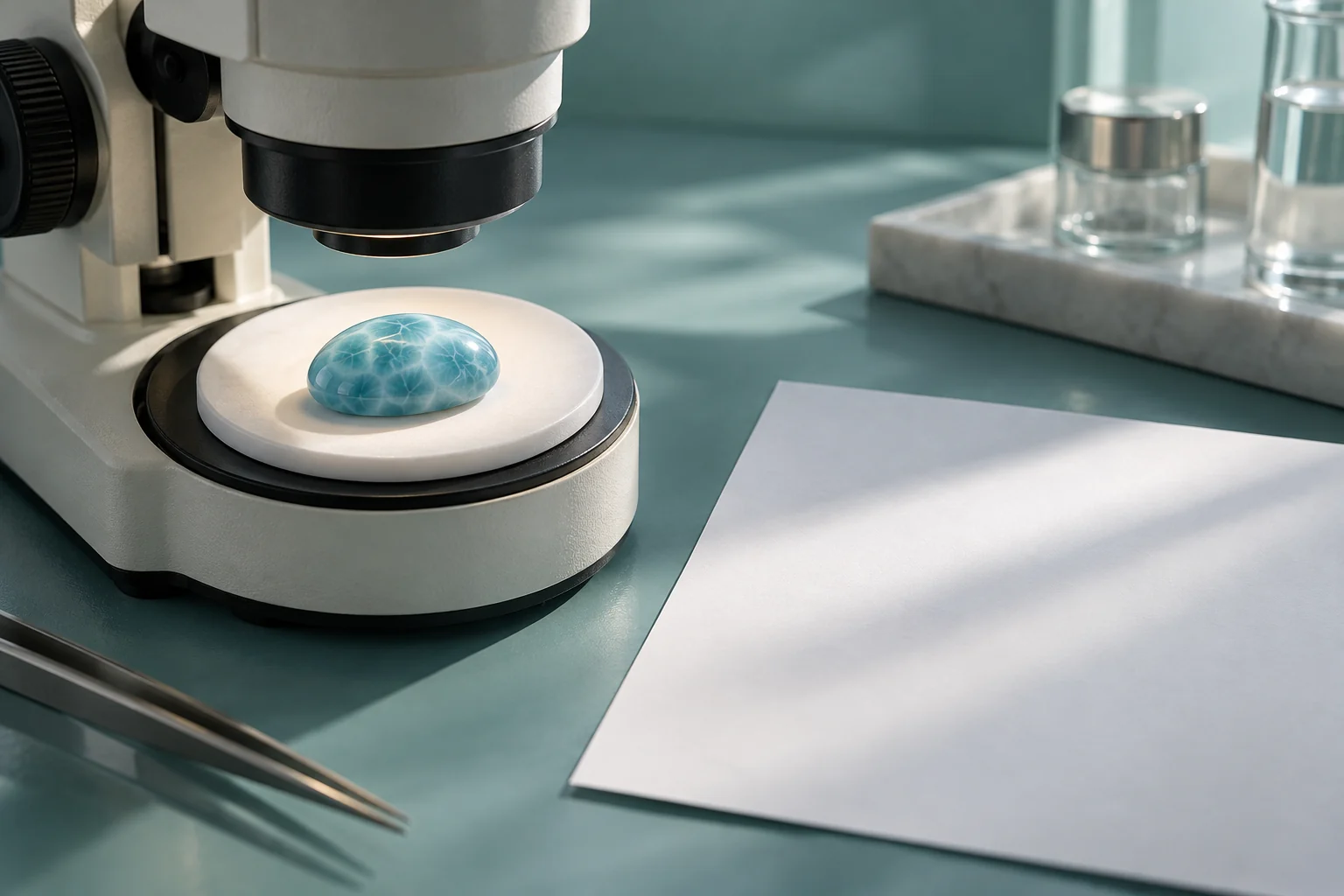
In 2013, GIA’s Gems & Gemology described a ceramic cabochon resembling Larimar. Microscopy and measured optical and density properties helped distinguish it from pectolite. The lesson is the combination of observations and tests, not a universal visual trick. This was a published examination of another specimen, not a test of our inventory. Follow the linked report for the original photographs; we do not present a generated image as documentary evidence.
Reference context: Kiefert & Groenenboom, Imitation Larimar (GIA, 2013)
How to verify a report without trusting a QR code
Find the laboratory’s official website independently, then use its report lookup if available. Compare the full record with the document supplied: number, issue date, item description, measurements and image. A valid number can still be attached to the wrong stone. If the record is missing or differs, contact the issuer through independently obtained details. Keep the purchase pending until the discrepancy is explained; a screenshot supplied by the seller is not independent verification.
Read a limitation as part of the result
A mounted stone may have inaccessible surfaces, while a report on one loose sample says nothing automatic about the rest of a parcel. Check whether treatment examination or geographic origin was actually within scope. “Not tested” and “no indication detected” are different statements. Ask the laboratory what its wording means for this examination rather than translating a missing comment into “untreated.” Keep the complete report with the item record, including limitations and attachments.
Agree what happens if the conclusion differs
Before purchase, put unresolved questions in writing: which item will be tested, which independent examiner is acceptable, who pays, and whether the return period allows time for examination. Specify the agreed consequence if identification differs from the listing or a stated claim cannot be supported. Do not remove a stone from its setting or alter its surface without agreement. Retain the quote, report, correspondence and arrival photographs as one linked record.
Questions answered
Does every Larimar stone need a laboratory report?
Not necessarily. Choose documentation according to the value, unresolved questions and importance of the claims. A report is not a substitute for checking that the stone received matches the one examined.
Does a QR code prove a Larimar certificate is genuine?
No. Independently locate the issuer’s official service, verify the record and compare the item details. A copied valid report number can accompany a different stone.
Sources & scope
A documented ceramic imitation and the role of gemological testing.
Mineral-species reference; properties of a particular gem or mixed specimen can require separate assessment.
Our initial library was developed with AI assistance. Product claims require separate item-specific evidence. Read our editorial standards.