
The key point
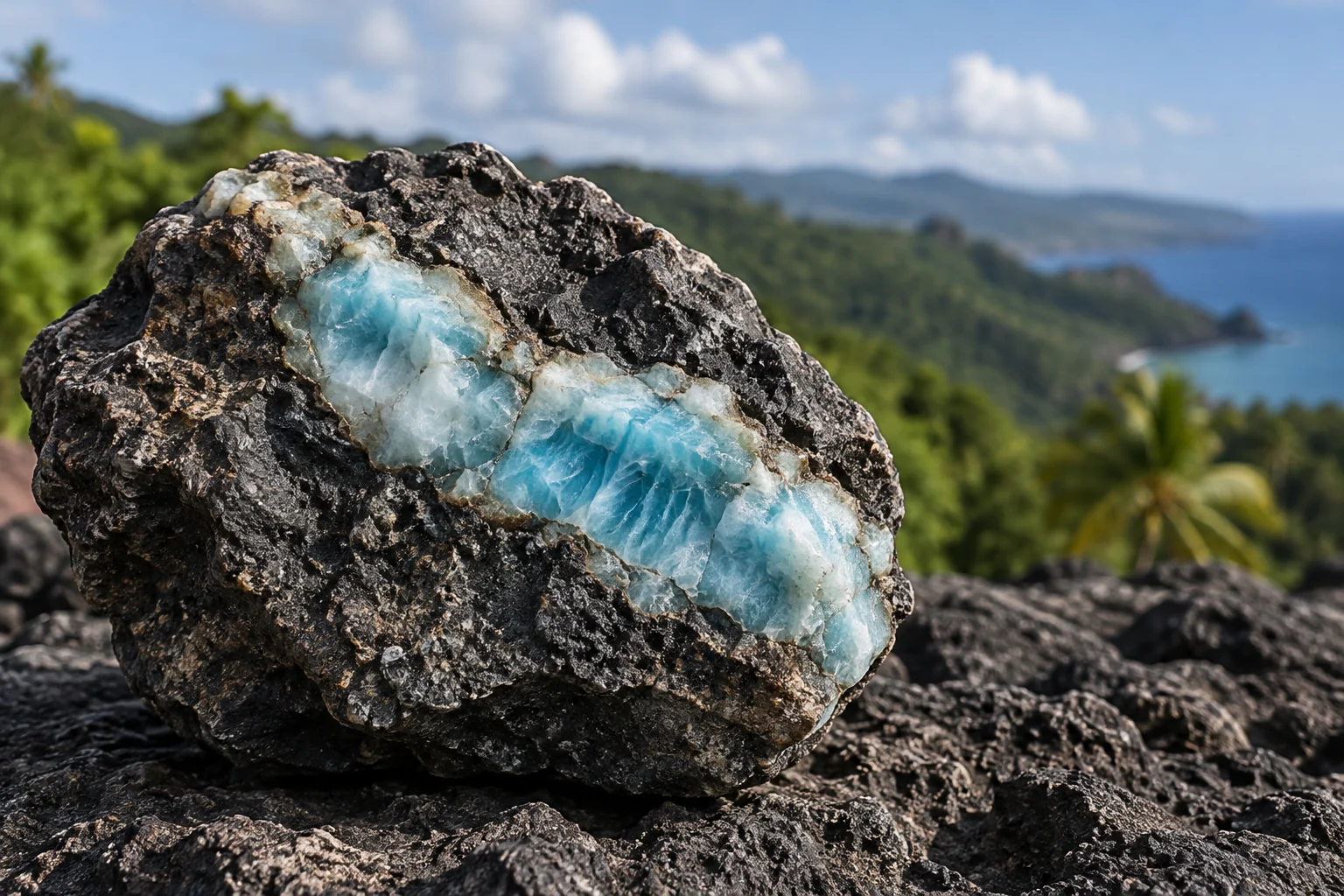
Larimar is associated with blue pectolite from the Barahona region in the southwest of the Dominican Republic. Published work describes mineral growth in altered volcanic rocks. Geological origin, modern discovery, and the documented supply history of a particular stone are three separate subjects.
Place: Dominican Republic, Barahona, and the deposit
Begin with a hierarchy of places. The Dominican Republic is the country; Barahona is the regional context most often attached to Larimar. A supplier’s town, a cutting workshop, and a retail shop are additional locations, not alternative answers to where the mineral formed. The official Dominican tourism description places the gemstone and its museum in that national context.
An origin story becomes less useful when these levels are mixed. A pendant bought in Santo Domingo did not necessarily come from a workshop in that city. A seller operating in another country can still sell a Dominican stone. Ask what each location in a description refers to.
Reference context: Dominican Republic Tourism: Larimar Museum
Formation: mineral growth within an altered rock environment
The publicly available abstract of a 2024 study describes blue pectolite in veins and cavities in altered Cretaceous basalt. Its authors link formation to relatively low-temperature mineralizing fluids and later mixing with meteoric water. This is a mineral-growth model supported by the study’s analyses, not a claim that a finished gem is a piece of frozen seawater.
It is useful to distinguish the material hosting a mineral from the mineral growing within it. An old rock can undergo later alteration or mineral growth. Consequently, naming a host-rock period does not by itself establish an exact formation date for a stone on a product page.
Reference context: Origin of bluish pectolite aka larimar (2024): abstract and publication record, AGH University
How old is Larimar—and is it fossilized wood?
There is no responsible way to assign one exact age to every retail stone from a broad description of its deposit. Ask what was dated, by which method, and whether the statement concerns rock emplacement or later mineralization. Human discovery dates answer neither of those geological questions.
An earlier 2017 study discusses mineral filling of open spaces and replacement of organic material in its formation interpretation. That gives context for discussions of wood replacement. It does not justify labeling every blue cabochon as petrified wood. A specimen sold specifically for that feature needs its own supporting observations or documentation.
Reference context: Petrographic contribution on the larimar host rock (Boletín Geológico y Minero, 2017)
Recorded history: why both 1916 and 1974 appear
The Larimar Museum’s account distinguishes an early written report in 1916 from rediscovery and recognition associated with Miguel Méndez and Norman Rilling in 1974. These refer to different stages of the modern story. The museum also explains the name through Larissa and mar.
Read historical dates with an event attached: report, recognition, naming, extraction, or use in jewelry. “Discovered in 1974” is an abbreviated account, not a description of the gemstone’s age. Where a precise historical detail is important, follow the named source instead of combining several unattributed retellings.
Reference context: Larimar Museum: Historia del larimar (Spanish)
From material in the ground to a finished piece
A supply chain can include extraction, sorting, rough trading, sawing, shaping, polishing, setting, and retail. Some stages may be performed by the same business, while others may be separated across countries. Educational information about the deposit does not document this chain for a particular object.
A useful provenance record follows the item or lot through identifiable records. It states which facts were observed directly and which came from a supplier. Keep item IDs, dates, photographs, and disclosure statements together. Where a link is unknown, record the gap rather than filling it with a plausible narrative.
What an origin claim can and cannot establish
“Dominican origin” concerns source geography. It does not automatically prove untreated material, local cutting, local manufacture, fair payment, or a verified environmental standard. Each of those is a different claim and needs an appropriate basis. A laboratory identity result also should not be expanded into an origin opinion unless the report actually states one.
For a seller claiming a direct mining relationship, ask what relationship is meant and how it is documented. Mine ownership, buying from a miner, buying from a cooperative, and buying through a trader are not interchangeable arrangements. Clear descriptions can be valuable even when the chain is not fully direct.
| Question | Useful evidence | Does not establish it alone |
|---|---|---|
| What is the material? | An appropriate identification examination | A landscape photograph |
| Where did it originate? | A stated origin opinion or relevant supply records | The seller’s address |
| Where was it cut or set? | Workshop records linked to the item | The mineral’s country of origin |
| How was it sourced? | Specific supplier and sourcing documentation | A general ethical label |
Reading current mine and supply claims
A historical geological paper is not a source for today’s visitor access, operating status, export conditions, or inventory. Claims that mining has stopped or stock is about to run out need dated and accountable evidence. A story repeated across sales websites does not become current simply through repetition.
For a purchase, establish whether the exact item is available, how long a reservation lasts, and what happens if it cannot be supplied. For learning in person, verify museum or operator arrangements directly. Our educational pages do not grant access to a deposit or claim that a particular mine is currently open to visitors.
Questions that make an origin story useful
Ask: Where did the rough originate? Where was it cut? Who made the setting? What records accompany this item? Which statements are supplier declarations and which have independent support? These questions work for a single pendant and for a wholesale lot.
A good answer does not need to be extravagant. A modest, documented supply history is more informative than an exceptional story without an item connection. The related guides below separate the geological models, historical accounts, and practical provenance questions in greater detail.
Questions answered
Can Larimar be cut or set outside the Dominican Republic?
The place of mineral origin and the place of manufacture are separate facts. Ask for both when they matter to your purchase.
Does the age of the basalt give the age of my pendant?
No. Host-rock age does not automatically date later mineral growth, and a finished item is not itself an age determination.
Explore this question further →Does Larimar come from the sea?
Its appearance and naming evoke the sea. Published geological explanations concern mineral growth in a volcanic-rock environment.
Sources & scope
Historical gemological investigation of Dominican blue pectolite; not an analysis of inventory on this website.
Our summary uses the publicly available abstract. Full paper DOI: 10.1016/j.jsames.2024.104949. It is a formation model, not a direct age determination for retail stones.
An earlier host-rock and formation interpretation, including discussion of organic replacement; it should not be generalized to every Larimar specimen.
The museum’s account of the historical reports, rediscovery, and naming of Larimar.
Official tourism context for the museum and Dominican deposit; check current visitor details with the venue.
Our initial library was developed with AI assistance. Product claims require separate item-specific evidence. Read our editorial standards.