
The key point
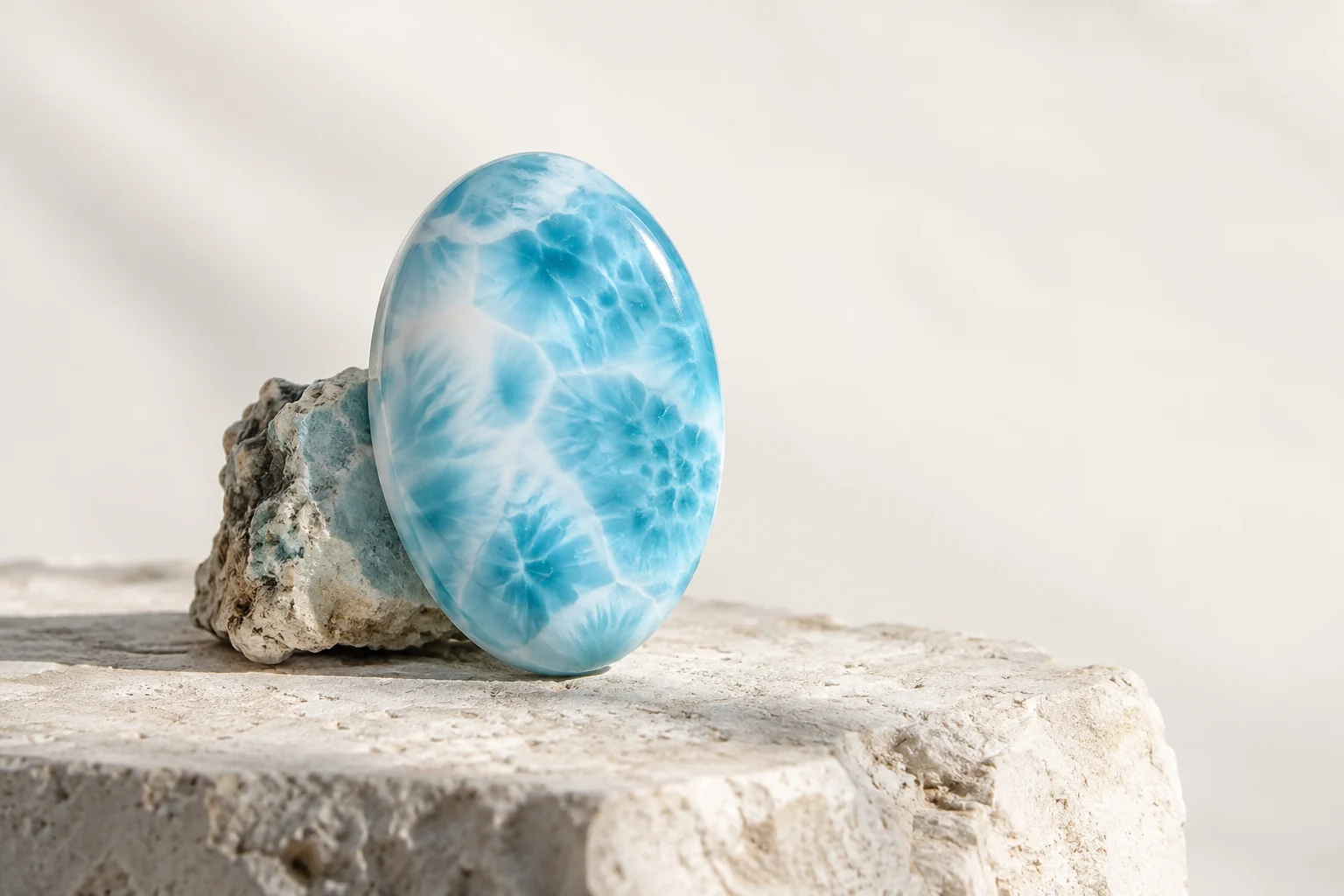
Larimar is the trade name associated with blue pectolite from the Dominican Republic. It is an ornamental gemstone used in polished stones, carvings, and jewelry. Its sea-like appearance is a natural mineral pattern, not evidence that it formed in seawater.
Larimar, pectolite, and the word gemstone
Three names answer three different questions. Pectolite identifies the mineral species. Larimar identifies the blue Dominican gem material in trade. Gemstone describes a use: material chosen and fashioned for ornament. Calling Larimar a gemstone does not mean it must be transparent or faceted. An opaque, rounded stone can be used as a gem.
The mineral reference gives pectolite’s ideal composition as NaCa₂Si₃O₈(OH), a sodium calcium silicate hydroxide. A natural piece can also contain associated material. A formula is therefore a starting point for understanding mineral identity, not a complete description of everything visible in a finished cabochon.
Reference context: Handbook of Mineralogy: Pectolite
Where the Dominican connection comes from
The historical gemological literature documents blue pectolite in the Barahona area of the Dominican Republic, in a volcanic-rock setting. This gives the name its geographic context. It does not establish who mined an item in a shop, where that item was cut, or where its jewelry setting was manufactured.
Keep those stages separate when reading a product story. “Dominican stone,” “cut in the Dominican Republic,” and “Dominican-made jewelry” can describe different things. A useful listing tells you which statements are documented for the exact piece rather than allowing one origin claim to imply all three.
Reference context: Woodruff & Fritsch, Blue Pectolite from the Dominican Republic (GIA, 1989)
Why it looks like water
The visual comparison is easy to understand: blue areas, pale contrasts, and changing reflections can resemble tropical water. The explanation is mineralogical. A 2023 study discusses both trace elements and fibrous-crystal orientation in the color and wave-like appearance of its samples. The popular copper-only explanation should not be treated as the complete, settled story.
For a buyer, the practical distinction is between appearance and identity. A pattern you enjoy is a sound aesthetic preference. It is not a test that proves a stone is Larimar. Likewise, the presence of a scientific explanation in a sales description does not show that the advertised piece has been examined.
Reference context: Revealing the Secrets behind the Color and Sea-Wave Patterns of Larimar (Minerals, 2023)
Raw, polished, or set into jewelry?
Choose the form by what you want to do with it. A raw specimen can preserve natural surfaces and host material. Rough intended for cutting needs an assessment of useful material, fractures, and possible orientation. A polished stone lets you judge a finished face, while a cabochon intended for setting also needs accurate measurements of its depth, edge, and underside.
Jewelry adds another set of decisions: metal, construction, size, comfort, and how securely the stone is held. An attractive stone and a well-made piece of jewelry are related but separate purchases. Do not let a photograph of the face distract from an unsuitable mounting or incomplete metal description.
| Form | Useful for | Check first |
|---|---|---|
| Raw specimen | Mineral collecting and display | Natural surfaces, size, host material, stability |
| Cutting rough | Lapidary projects | Accessible faces, fractures, estimated yield |
| Loose polished stone | Collecting or jewelry making | All surfaces, dimensions, intended setting |
| Finished jewelry | Wearing or gifting | Metal, fit, retention, maintenance |
Is Larimar the same as turquoise or aquamarine?
No. These are different gemstone names. Similar blue color does not make one a variety or grade of another. Treat “Larimar blue” as a color description unless the listing also gives an unambiguous material identity. For anything described as Larimar-like, imitation, or composite, ask what the material actually consists of.
Comparisons are most useful when they answer your purpose: a blue palette for a design, a mineral for a collection, or a piece suitable for a particular wearing routine. A lookalike may meet an aesthetic brief if sold honestly, but it should not be represented as the natural gemstone you intended to buy.
What the name means—and what it does not
The Larimar Museum links the name to Larissa, Miguel Méndez’s daughter, and mar, the Spanish word for sea. That naming story is part of its cultural history. It does not date the mineral’s formation, certify a supply chain, or establish therapeutic properties.
Personal symbolism can be meaningful without making those claims. A stone can remind someone of a place, an ocean, or a relationship. We describe those associations as personal or cultural meanings and keep them separate from geological findings and evidence about a product.
Reference context: Larimar Museum: Historia del larimar (Spanish)
The five facts to record before buying
Start a simple item record: exact item ID and photographs; dimensions and weight; stated material identity; disclosed treatments or construction; and written sale and return terms. For jewelry, add the metal description and how the stone is secured. For rough, add whether the photographs show dry or wet material and whether a yield estimate has been made.
This record does more for a considered purchase than collecting adjectives such as rare, premium, or ocean-grade. It lets you compare candidates, check the delivered piece, and pass accurate information to a jeweler or the person receiving a gift. Unknown information should remain marked as unknown.
Where to go next
For the geological story, read the origin and formation guide. For a questioned stone, start with the authenticity guide rather than a scratch test. For a purchase, use the quality and buying framework. For an item you own, follow the care guide and the instructions for its particular setting.
This overview explains the subject; it is not an identification report for your stone. Our illustrations show the design concept, while any future stock listing must provide photographs and evidence for the actual merchandise.
Questions answered
Is Larimar a crystal or a gemstone?
Pectolite has a crystalline mineral structure; gemstone describes the ornamental use of suitable material. The words describe different aspects of the same subject.
Is every blue stone from the Dominican Republic Larimar?
No. Location and blue color alone do not identify a mineral. Ask for the stated identity and evidence supporting it.
Explore this question further →Does natural mean untreated?
No. Natural origin and treatment history are separate claims. Ask what is known about modifications and how that was determined.
Explore this question further →Sources & scope
Historical gemological investigation of Dominican blue pectolite; not an analysis of inventory on this website.
Mineral-species reference; properties of a particular gem or mixed specimen can require separate assessment.
A sample-based study of trace elements and optical effects; proposed color mechanisms should not be described as a universal authentication test.
The museum’s account of the historical reports, rediscovery, and naming of Larimar.
Our initial library was developed with AI assistance. Product claims require separate item-specific evidence. Read our editorial standards.