
The key point
Vocabulary for loose stones, jewelry, reports, and wholesale sourcing.
Stone forms
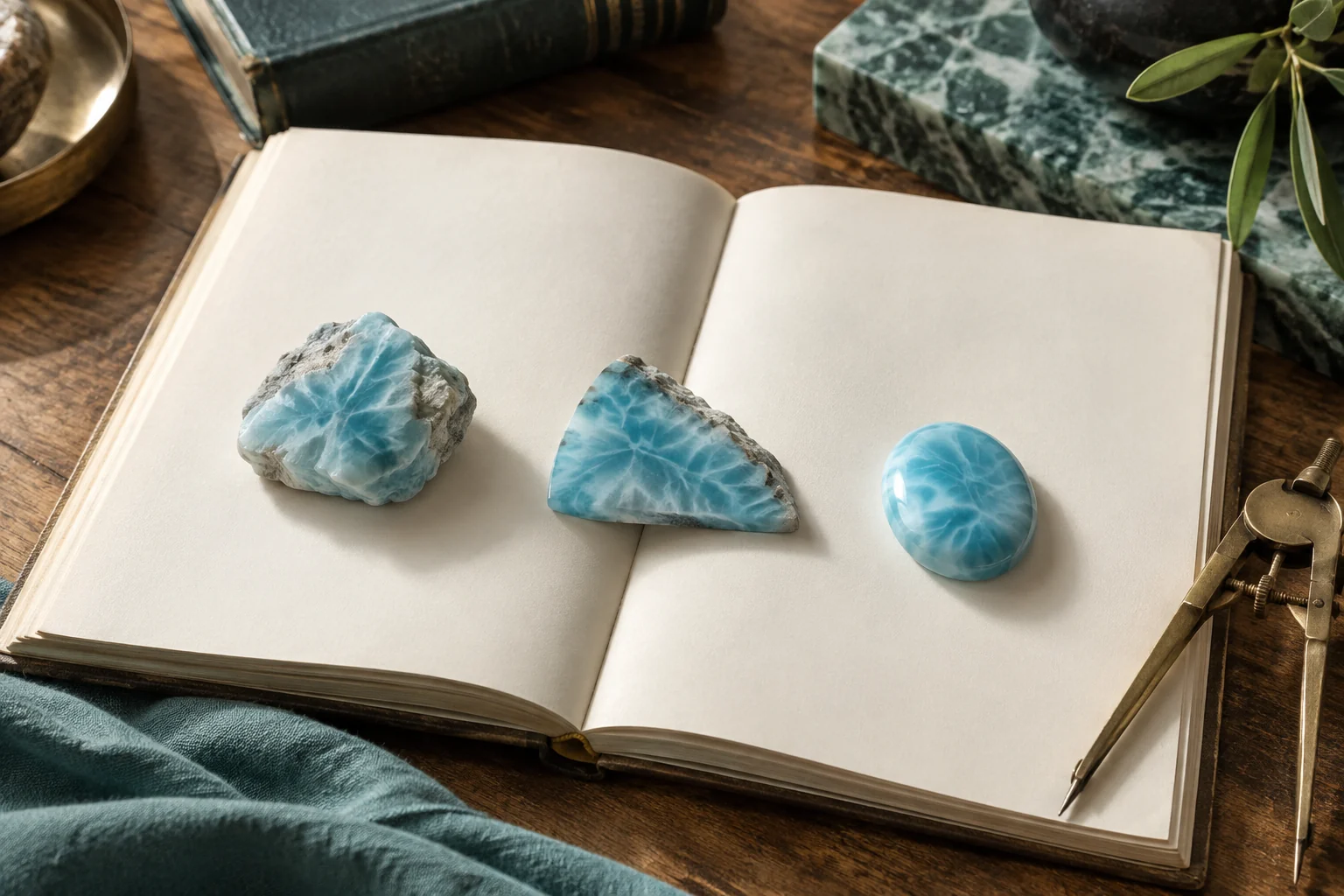
Rough is material before final shaping and polish. A slab is a sawn section. A cabochon has a rounded face. A freeform has an outline outside a regular calibrated shape. A specimen is collected for mineral or display interest, not necessarily cutting value.
Measurements
One carat equals 0.2 grams. Dimensions usually give length, width, and depth in millimeters. Calibrated describes intended size and shape, with tolerances requiring agreement. Yield describes usable output relative to input; estimates must identify assumptions.
Appearance and condition
Matrix is surrounding or associated material. An inclusion is enclosed material; naming it may require examination. A fracture is a break or separation. Polish is surface finish. These characteristics should not be collapsed into an unexplained grade.
Construction
A bezel holds a stone within a rim. Prongs retain it at points around the edge. A bail connects a pendant to a chain or cord. A hallmark or stamp needs interpretation in context and does not establish every claim about an item.
Documentation
Identification concerns material identity. Treatment disclosure describes known modifications. Provenance documents history or supply path. An appraisal estimates value for a stated purpose. Seller paperwork is not automatically independent; read issuer, scope, and item linkage.
About this guidance
This guide provides practical purchase questions, terminology, or clearly labeled interpretation. It does not claim laboratory testing, field observation, current market research, or independent expert review.
Our initial library was developed with AI assistance. Product claims require separate item-specific evidence. Read our editorial standards.