
The key point
Choose Larimar by comparing the actual pieces under consistent conditions: identity and disclosure, appearance, visible condition, shape and finish, suitability for use, and the complete purchase terms. A seller’s quality label is useful only when its criteria are clear.
Start with the intended use
Before discussing quality, define the job. A display specimen, a ring cabochon, a matched earring pair, and a rough lot are not judged on identical criteria. List what the piece must do: fit a setting, stand on a base, match another stone, or yield material for cutting. Identify non-negotiable measurements and conditions.
Then choose aesthetic preferences. You might favor a broad uniform blue, strong white contrast, a freeform outline, or a distinctive natural feature. A preference is legitimate without being a universal grading rule. Separating purpose from taste makes supplier recommendations easier to evaluate.
Identity and disclosure come before aesthetic comparison
Record the stated material identity and known treatment or construction information. Decide whether a report is appropriate for the purchase. A beautifully photographed piece with an ambiguous material description should not be compared as though it were equivalent to a clearly documented one.
Keep unknowns visible. “Not disclosed” is not the same as “tested and absent.” The same principle applies to origin and metal composition. If a claim changes the price you are willing to pay, resolve the meaning and evidence before treating it as a benefit.
Compare color and pattern under consistent conditions
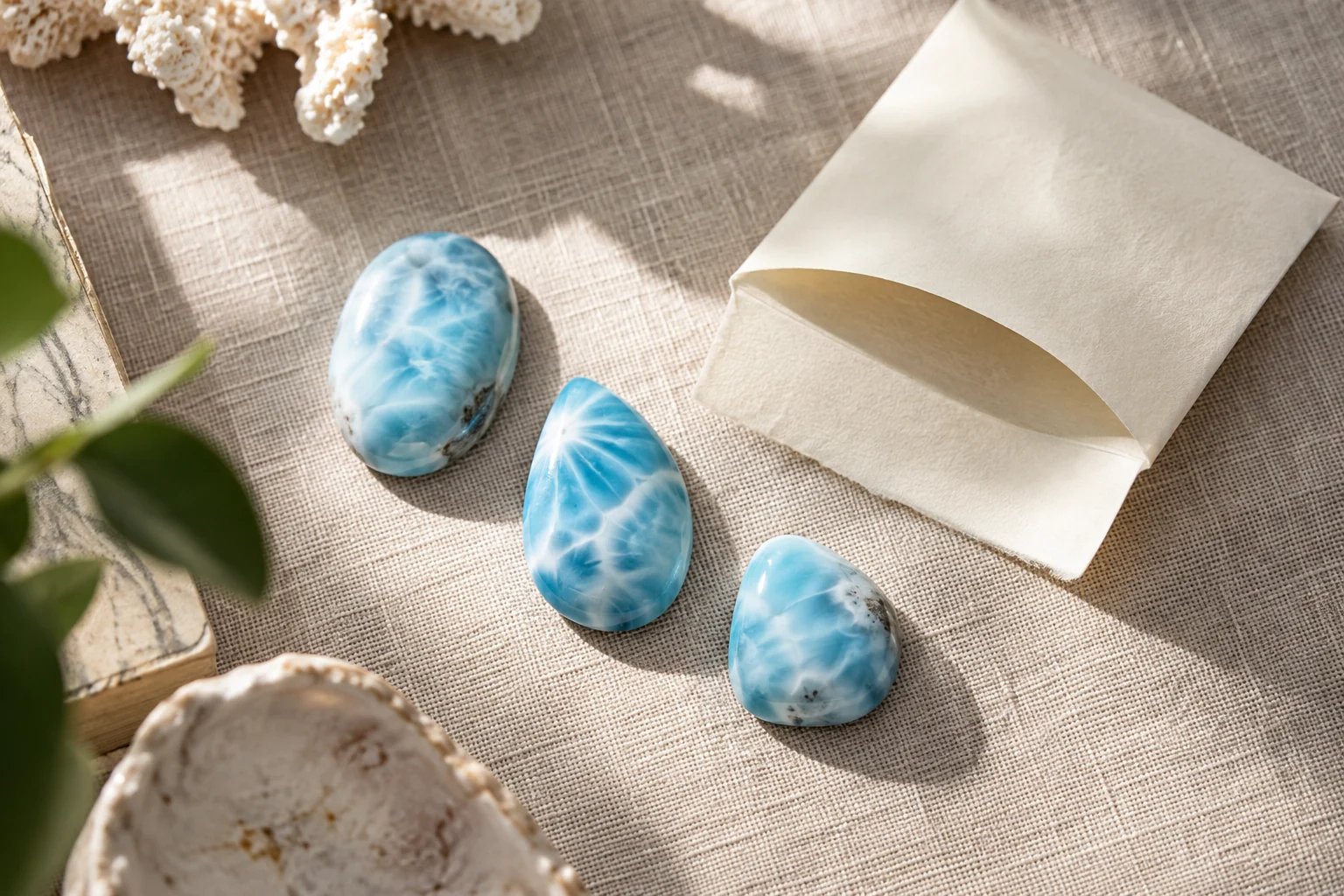
Request a common neutral background, similar lighting, front and back views, and a short video. For pairs, view both stones together. Ask whether rough was photographed wet. Avoid comparing the most dramatic image from one supplier with a muted image from another; you may be comparing photography rather than material.
Describe your preferences in observable terms: blue-to-white balance, pattern distribution, conspicuous dark areas, and what should appear on the visible face. Ask to see features at an edge or back if the design exposes those surfaces. Screen color cannot be guaranteed, so inspection and return arrangements matter.
Assess condition, shape, and finish separately
Ask for images of visible lines, chips, irregular edges, and any filled or repaired areas. Do not name a mineral inclusion or diagnose a fracture from a vague photograph. Request clarification or examination when the feature matters to structural suitability. A natural feature can be attractive while still affecting a planned use.
For a polished stone, inspect the outline, dome, edge, back, and surface finish. For a setting, obtain length, width, and total depth and have the maker approve the actual stone. A nominal size does not capture every contour. For rough, discuss likely usable material without treating gross weight as finished output.
Turn grades into a written specification
Ask the seller what AAA, AA, premium, or similar labels mean in that business. Who assigned the grade? Which criteria are included? Is the assessment independent? Do not assume identical letters across suppliers indicate an identical standard.
A more useful specification states dimensions and tolerances, pattern preference, acceptable visible features, polish expectations, and required disclosure. For a lot, define permitted variation and how nonconforming pieces are handled. The purpose is agreement, not a homemade claim to laboratory grading.
Compare complete prices rather than isolated units
One carat is 0.2 grams. A rough price per gram and a polished price per carat refer to different products and different amounts of processing. For jewelry, record whether the weight is the stone alone or the complete item. Include metal, workmanship, findings, and any chain in the comparison.
Ask for a written quote separating the goods, currency, shipping, and charges collected by the seller. Check what may be payable at the destination and what return costs apply. We do not publish an invented universal price-per-carat chart or promise that rarity produces future appreciation.
Use a worked comparison—not a universal score
Imagine two illustrative cabochons: A fits your approved setting and shows a pattern you like, with clear exact-piece photographs. B has a stronger advertised grade but lacks depth measurements and uses a sample image. You cannot conclude B is a better purchase from its grade alone. Resolve those unknowns before comparing value.
For an earring pair, a larger individual stone can be less useful than a smaller well-matched pair. For rough, a cheaper lot can be less economical if too little material meets your cutting brief. These examples explain a decision method; they are not observations about our current stock or a market price dataset.
| Criterion | Candidate A | Candidate B |
|---|---|---|
| Exact item ID and images | Record or mark unknown | Record or mark unknown |
| Length × width × depth; weight | Use stated units | Use stated units |
| Identity, treatments, construction | Keep claims and evidence separate | Keep claims and evidence separate |
| Pattern, condition, fit for use | Describe observable features | Describe observable features |
| Total cost and inspection terms | Include relevant charges | Include relevant charges |
Confirm the order and inspect delivery
Your final record should include approved item IDs and photographs, measurements, disclosures, quantity, total quote, reservation timing, dispatch expectations, and inspection and return arrangements. Save it before payment. For a custom setting, establish approval stages and what happens if the stone cannot be used as planned.
On arrival, compare the actual items with that record in consistent light. Document discrepancies before cleaning, cutting, setting, or otherwise modifying material. A considered purchase ends with checking what was delivered—not with accepting a quality adjective at the beginning.
Compare a Larimar quote by weight
Enter one currency throughout. One carat equals 0.2 grams. Compare like material and condition: a low unit price does not establish authenticity, quality, or usable yield.
Enter a non-negative price and positive stone weight to calculate.
Formula: (item price + entered charges) ÷ stone weight. Include only charges you know; omitted duties or fees are excluded. For jewelry, use the stone’s weight, not the combined metal and stone weight. The result is a comparison aid, not a market valuation.
Save a comparison record
Use the same fields for each candidate. This blank worksheet records observations and unknowns; it does not assign a laboratory grade.
Download the blank worksheet ↓Questions answered
Is the darkest Larimar always the best?
Best depends on the purpose and your preference. Color does not resolve condition, identity, setting fit, finish, or commercial terms.
Can AAA labels be compared across stores?
Only after you understand each seller’s criteria. Similar letters do not establish a common independent grading standard.
Explore this question further →What should I ask before buying rough?
Ask for all accessible faces, dry as well as wet photographs, dimensions, gross weight, visible concerns, and the basis of any yield estimate.
Explore this question further →About this guidance
This guide provides practical purchase questions, terminology, or clearly labeled interpretation. It does not claim laboratory testing, field observation, current market research, or independent expert review.
Our initial library was developed with AI assistance. Product claims require separate item-specific evidence. Read our editorial standards.