The key point
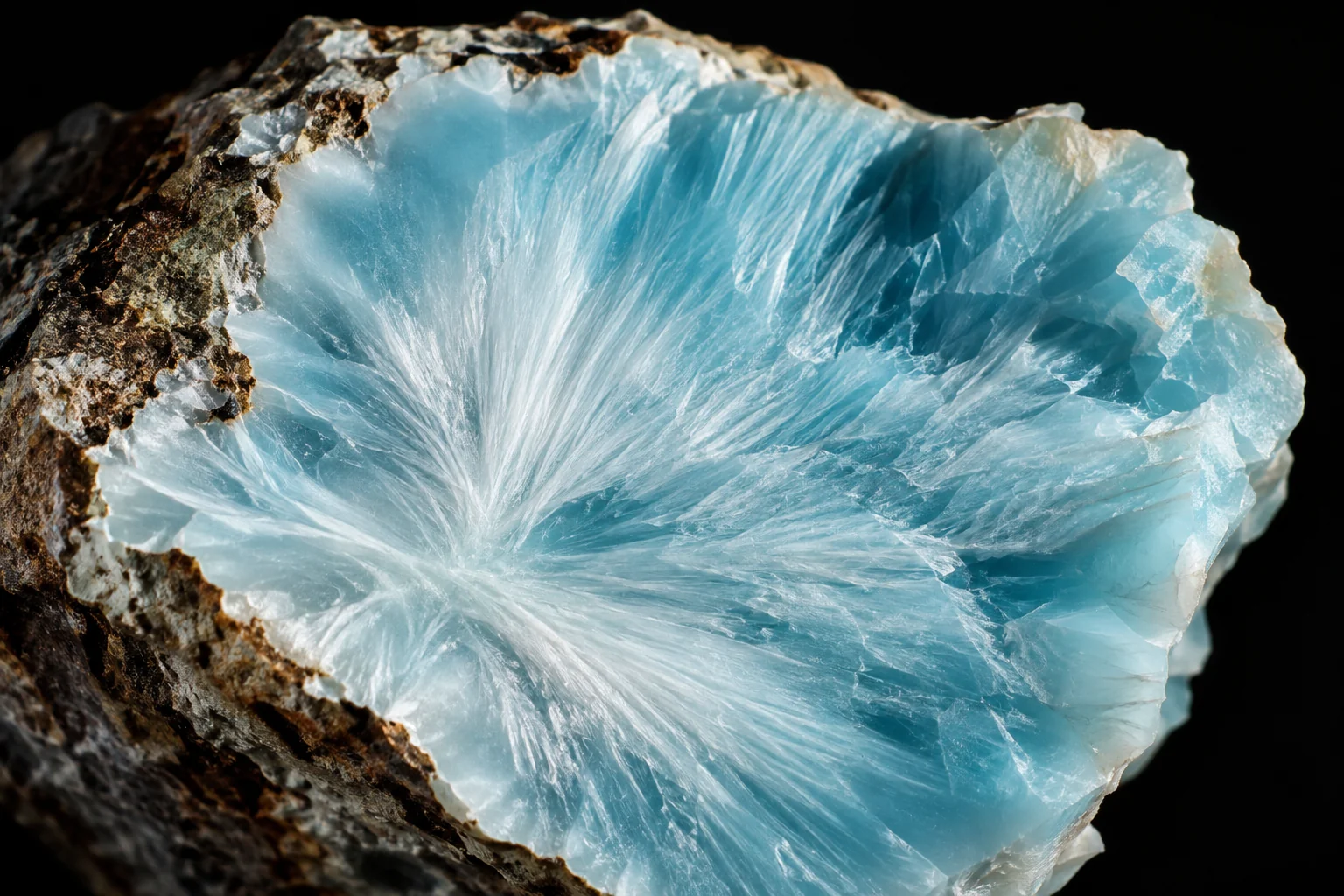
Larimar is the trade name for Dominican blue pectolite. Pectolite has the ideal formula NaCa₂Si₃O₈(OH), triclinic symmetry and a reference Mohs hardness of 4.5–5. Mineral reference values help describe the material; they do not authenticate a stone from a photograph.
The mineral behind the trade name
Pectolite is a sodium calcium silicate hydroxide, with the ideal formula NaCa₂Si₃O₈(OH). The Handbook of Mineralogy describes triclinic crystal symmetry and several growth forms, including fibrous and massive material. A mineral species has a defined structure and chemistry; a trade name describes material recognized and sold in the gemstone market.
Reference context: Handbook of Mineralogy: Pectolite
More than one mineral
Natural gem material can include host rock, veins, or other mineral constituents. A polished stone is not necessarily a uniform chemical sample. A reading taken from one region may not represent every visible part of a specimen. Describe the actual sample and test method when interpreting results.
Physical properties have limits
Reference hardness, density, and optical properties assist trained identification when measurements are made appropriately. They are not interchangeable with a phone photograph or a weight taken without a volume measurement. Mounted stones and irregular rough introduce practical constraints that a laboratory must account for.
What a formula does not establish
The ideal formula alone does not determine retail price, origin records, treatment history, or durability in a particular setting. Those questions need separate evidence. Read a laboratory report for its actual conclusions and limitations rather than treating it as a guarantee of every statement on a listing.
Pectolite reference data, with context
The table separates mineral-species data from gemological observations published by GIA. Specific gravity is a density ratio, not the weight of a stone. A refractive-index measurement describes how light behaves in a material; a spot reading on a curved cabochon is not equivalent to a full set of readings on a suitable polished surface. Different source values should retain their original context rather than being merged into an exact specification for every Larimar.
Reference context: Handbook of Mineralogy: PectoliteKiefert & Groenenboom, Imitation Larimar (GIA, 2013)
| Property | Reference value | Source and scope |
|---|---|---|
| Ideal formula | NaCa₂Si₃O₈(OH) | Handbook of Mineralogy |
| Crystal system | Triclinic | Handbook of Mineralogy |
| Mohs hardness | 4.5–5 | Handbook of Mineralogy |
| Measured density | 2.84–2.90 g/cm³ | Handbook of Mineralogy |
| Cleavage | Perfect on {100} and {001} | Handbook of Mineralogy |
| Typical spot refractive index | ≈ 1.60 | GIA, 2013: gemological comparison |
Hardness, cleavage and toughness are different
Mohs hardness compares resistance to scratching. It does not measure resistance to a fall, pressure from a setting or a sudden temperature change. Pectolite has cleavage, so the direction and condition of an impact also matter. For jewelry, assess the stone together with its edge protection, thickness, existing fractures and intended wear. A pendant and a ring expose the same mineral to different situations. Do not scratch a finished stone to confirm a number from a chart.
Reference context: Handbook of Mineralogy: Pectolite
Does pectolite occur outside the Dominican Republic?
Yes. Pectolite is a mineral found in multiple countries; Larimar is the trade name associated with Dominican blue gem material. These statements are compatible. A locality record for pectolite elsewhere does not automatically establish another commercial Larimar source. Likewise, a mineral identification does not by itself document the supply history of an individual item. Keep mineral species, trade name and provenance as separate fields in a collection or purchase record.
Reference context: Handbook of Mineralogy: PectoliteKiefert & Groenenboom, Imitation Larimar (GIA, 2013)
Questions answered
Is Larimar a mineral or a gemstone?
Pectolite is the mineral species. Larimar is the trade name for Dominican blue pectolite used as a gem or ornamental material. The terms describe different levels of classification.
Can hardness prove that Larimar is genuine?
No. A hardness value is one property shared or overlapped by other materials. Scratching can damage the item. Identification should combine suitable non-destructive observations and tests.
Explore this question further →Sources & scope
Mineral-species reference; properties of a particular gem or mixed specimen can require separate assessment.
A documented ceramic imitation and the role of gemological testing.
A sample-based study of trace elements and optical effects; proposed color mechanisms should not be described as a universal authentication test.
Our initial library was developed with AI assistance. Product claims require separate item-specific evidence. Read our editorial standards.