
The key point
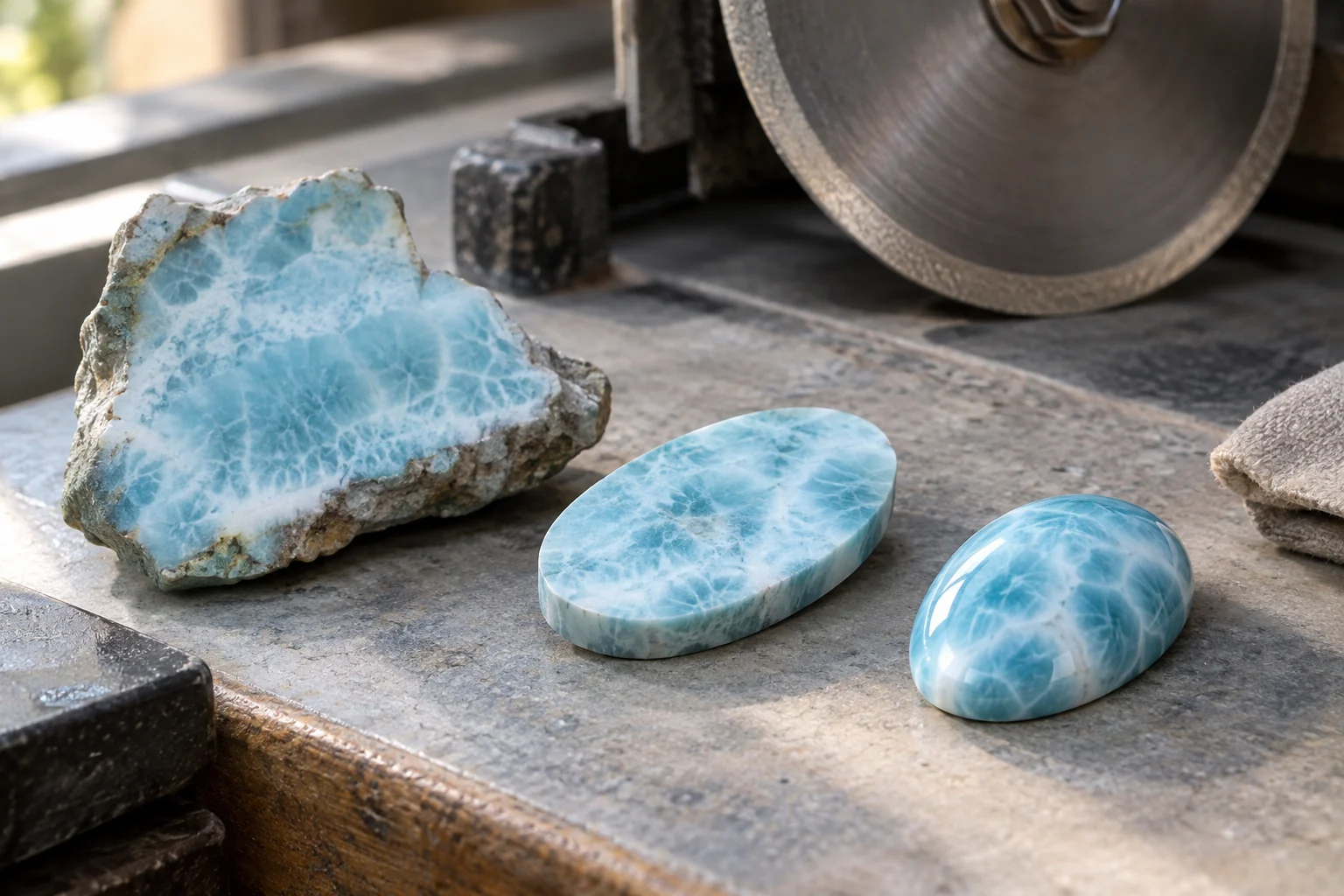
A good Larimar cutting plan balances visible pattern, sound material, final dimensions and usable yield. Agree on the desired face and minimum dimensions before cutting. There is no justified universal yield percentage or polishing recipe for every piece of rough.
Inspect and plan
Photograph the rough and identify faces showing useful pattern. Discuss likely fractures and final dimensions with the lapidary. Orientation trades material retention against appearance and shape. Material selected for a broad pendant needs a different plan from a pair of narrow earrings.
Agree on the outcome
Record preferred face, outline, minimum dimensions, acceptable features, and whether weight retention or pattern is the priority. Ask what happens if a hidden feature changes the plan. Cutting cannot be reversed; a documented agreement helps avoid mismatched expectations.
Avoid a universal recipe
Equipment, abrasive sequence, pressure, and polishing compounds depend on the material and workshop. This guide is a planning aid, not lapidary training or equipment instructions. Have the operator evaluate the specimen and use controls and protective practices appropriate to the process.
Inspect finished work
Check dome, outline, edge, back, and polish in consistent light. Confirm dimensions with the setting maker before metalwork begins. Record changes from the plan. For pairs or calibrated lots, measure each piece rather than assuming one attractive sample represents all of them.
Plan a pendant, a pair or a calibrated stone
Start with the finished use, not a promise to preserve maximum weight. A freeform pendant may follow a sound area with an irregular outline. A matched pair needs two compatible finished pieces, so one excellent face is insufficient. A stone for an existing setting must meet its actual dimensional requirements, including depth and edge geometry. A nominal label such as 20 × 15 mm does not establish that the underside will fit. Share the setting or an agreed drawing with the lapidary before approving the outline.
Calculate yield without inventing a market average
Finished usable mass ÷ starting rough mass × 100 gives the yield for a defined project. Keep both weights in the same unit and state what counts as usable output. Teaching example: 100 g of rough producing 20 g of accepted finished stones has a 20% yield. If that rough cost 80 currency units, its material cost is 4 per finished gram, before labor, abrasives, fees and rejects. This is arithmetic, not a typical Larimar yield or price. Record leftover material separately if it may be used later; do not count it as accepted finished stock.
A written brief for the workshop
Use the checkpoints below to agree on decisions and inspection. These are commissioning and quality-control questions, not equipment settings. The mineral’s hardness and cleavage explain why handling deserves attention, but they do not establish a safe abrasive sequence or polishing compound for an unknown specimen. If a workshop finds a hidden fracture, pause for a revised plan rather than silently accepting a smaller or differently oriented stone. Retain before-and-after images with the same item ID.
Reference context: Handbook of Mineralogy: Pectolite
| Stage | Record or agree |
|---|---|
| Before cutting | Item ID, rough mass, chosen face, target outline and minimum dimensions |
| After opening the rough | New fractures or pattern changes; approval of any revised plan |
| Before mounting | Actual length, width, depth, edge and underside fit |
| Final acceptance | Finished mass, condition, polish, matching and retained photo record |
Questions answered
What percentage of rough Larimar becomes finished stones?
There is no single percentage justified for all rough. Shape, fractures, matrix, chosen pattern and required dimensions change the result. Measure actual accepted output against the defined starting mass for each project.
Sources & scope
Mineral-species reference; properties of a particular gem or mixed specimen can require separate assessment.
Our initial library was developed with AI assistance. Product claims require separate item-specific evidence. Read our editorial standards.