
01 / Buying with clarity
How to compare two Larimar stones before buying: a worked example
Compare two hypothetical Larimar offers using dimensions, photographs, disclosures and purchase terms. Includes a printable comparison worksheet.
Compare Larimar against the same intended use, not just the strongest blue photograph. Check dimensions and profile, request comparable images of the exact pieces, separate appearance from identification evidence, and compare the complete purchase terms. When essential information is missing, the right decision can be to wait.
Start with the project, not the photograph
Imagine choosing an oval cabochon for a pendant. Write down the dimensions, profile and setting requirements with your jeweler first. Two stones with the same face dimensions can have different thicknesses and backs. Neither is automatically better: the useful question is which can be set appropriately for this project.
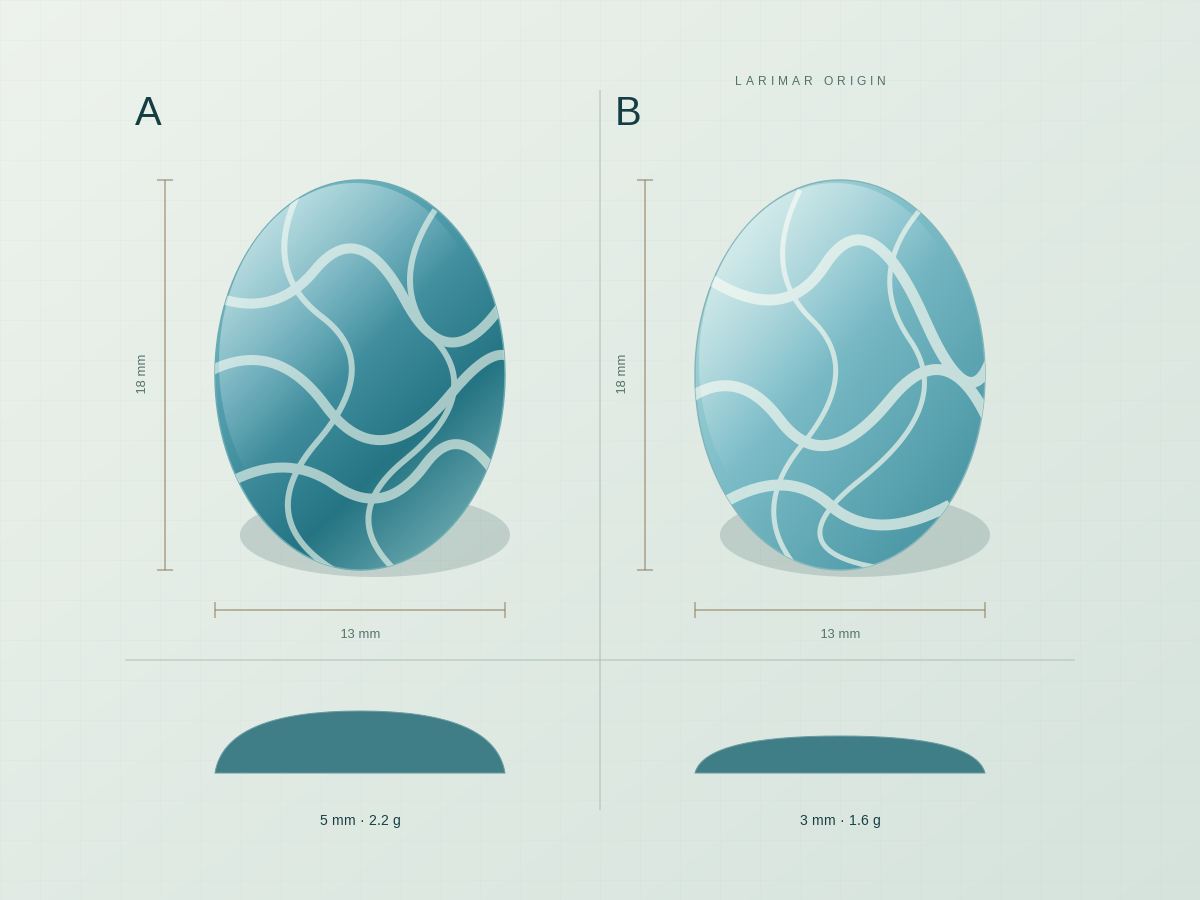
| What to check | Offer A | Offer B |
|---|---|---|
| Dimensions | 18 × 13 × 5 mm | 18 × 13 × 3 mm |
| Weight | 2.2 g | 1.6 g |
| Photographs | One wet front view | Dry front, back and side views |
| Material disclosure | Description not yet confirmed | Written description supplied; not independently verified |
| Inspection and returns | Not yet stated | Written terms supplied; conditions still to review |
Make the photographs comparable
Offer A looks darker blue, but its only image is warmly lit and shows a wet stone. B has dry front, back and side images in neutral light. Ask A for equivalent views and both sellers for a short unfiltered video. This improves comparison; it does not establish identity or precisely reproduce color on your screen.
Keep appearance and identity separate
An attractive pattern cannot prove that a stone is Larimar. Ask for the material description, treatment and construction disclosures, exact item ID and any relevant report. Check that a report matches this piece and read its scope. If identity remains material to your decision, discuss appropriate independent examination. Avoid scratch or heat experiments.
Compare the complete offer
Record the quoted amount and currency alongside metal or setting costs, delivery, applicable import charges and written inspection or return terms. These are questions to confirm, not promised benefits. Do not derive value from price per gram alone: dimensions, condition, usable form and evidence can change whether an offer meets your needs.
Decide what is still missing
In this example, B is easier to assess because its photographs and terms are better documented. That does not prove B is genuine or better quality. Ask A for the missing evidence and confirm whether B's thinner profile suits the setting. If either seller leaves a decisive question unanswered, pause rather than award a winner.
For wholesale, separate the sample from the lot
A well-documented sample does not describe every item in a shipment. Agree on dimensions, acceptable variation, disclosure requirements, sampling and the response to nonconforming pieces. Record what was actually inspected. The comparison sheet can organize that discussion, but it is neither a grading system nor certification of a lot.
Better evidence. A more informed decision.
Record what you know, what the seller claims and what still needs checking in separate fields. A visible advantage in documentation is a reason to investigate further, not an authenticity verdict or a guarantee of value.
Comparison notes
Your comparison worksheet
- Intended use and required dimensions
- Seller, date, exact item ID and listing URL
- Length, width, thickness, weight and units
- Dry front, back, edge and profile photographs
- Material, treatment and construction disclosures
- Report issuer, number, scope and item match
- Total quoted costs and written purchase terms
- Unanswered questions and the next decision
Is the darker blue stone the better purchase?
Color preference alone does not decide suitability, condition or identity. Compare the exact pieces under similar conditions and check the intended use.
Does the heavier stone offer better value?
Not necessarily. More weight may reflect a thicker profile or material that does not help your design. Compare usable dimensions and the complete offer.
Can this worksheet authenticate Larimar?
No. It organizes observations, disclosures and evidence. An unresolved identification question may require examination by a qualified gemologist.
Sources and method
This is an original purchasing framework, not a laboratory study. The sources below support the distinction between visual assessment and mineral identification; they do not certify these fictional offers.
Editorial standards →