
The key point
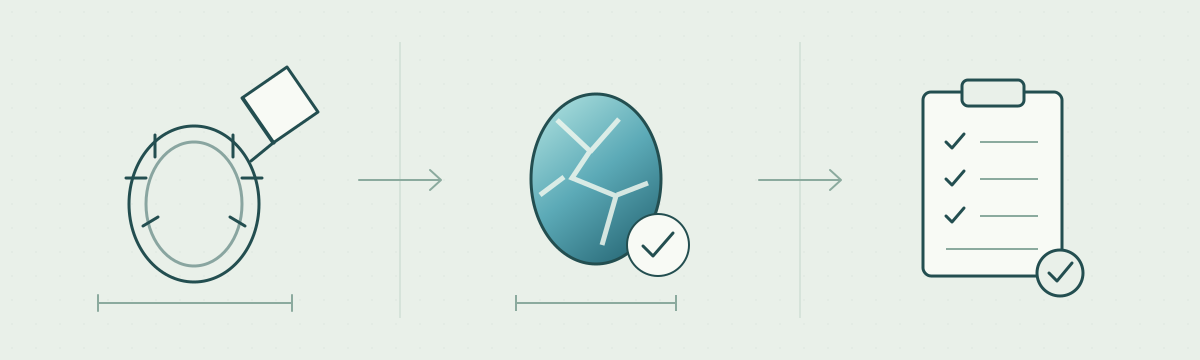
Start with an independent jeweler’s assessment of the existing mount, then request a replacement stone against their approved specification. Equal carat weight or a familiar oval size does not establish fit. Agree who supplies the stone, who approves it and who undertakes any shaping or setting before buying. Larimar Origin accepts stone inquiries; this guide does not offer repairs, fitting or custom cutting.
Start with the loss or damage record and a jeweler’s assessment
When the original stone is available or missing
Stop wearing a piece with a loose or damaged stone. Keep the jewelry and any recovered fragments protected and separate; avoid trying to force a stone back into place. A photograph can help explain the situation, but cannot establish the condition of the mount. Have an independent jeweler examine it before searching for a replacement. Tell them it is described as Larimar and disclose any previous work or known treatments.
If the original stone survives, retain it even when chipped. Its outline and profile may help the jeweler prepare a specification, while damage can make its present measurements unreliable. If only fragments remain, label them as fragments rather than an intact dimensional reference. If the stone is missing, collect earlier photographs, an invoice, maker’s details and any original stone measurements. Do not substitute the outside dimensions of the ring or pendant for the dimensions of the stone seat.
Ask the original maker whether any service arrangement applies before authorizing alterations elsewhere. Separately ask your chosen jeweler whether they accept customer-supplied Larimar and whether the existing mount can be used. Record what they can assess, what needs examination after dismantling and what remains unknown. A missing stone may expose a mounting problem; replacing it without assessing that problem can leave the underlying issue unresolved.
Get a stone specification approved for the existing setting
Measurements, profile and fit approval
Ask the person who will set the stone to approve the specification. It should identify the jewelry, intended stone outline, length, width and depth in millimeters, relevant side and back profiles, and the measurements or reference drawing they require. State who measured each item and whether the measurement comes from a surviving stone, the empty mount or an old listing. Leave unknown fields open rather than estimating a precise size from a photograph.
Two stones with the same face-up dimensions may differ below the visible surface. Their curved sides, edge thickness, dome and underside can interact differently with the seat and retaining metal. A nominal calibrated size is a starting point for a search, not the setter’s acceptance of a particular stone. This guide gives no universal fitting allowance. Your jeweler must decide what can be accommodated by that mount and what, if anything, would need to change.
For example, a seller may describe two candidates as the same oval size. One has a deeper body and the other a flatter back. Their listing dimensions alone do not tell you which can be securely set in your pendant. Send exact-item side and back photographs and the requested measurements to the jeweler. Obtain approval of the candidate and any remaining inspection conditions before committing to alteration.
Agree the appearance brief when the original is missing
Treat resemblance and fit as separate decisions. An old photograph can communicate a preference for a pale or deeper blue, fine white lines or larger white areas. It cannot promise an identical replacement. Record which features matter most and where you would accept variation. A surviving earring or another item from a set can be a useful comparison reference, but finding a visually close companion still requires evaluation of actual candidates.
Request photographs of the exact proposed stone, identified by a stable item number, showing its face, sides and back. Ask whether the photographs show dry material and what lighting was used. Where possible, compare the reference and candidate under similar conditions. Screen settings, reflections and exposure can change the impression of color; do not approve a precise match from a heavily edited image or a collection photograph.
Keep the seller’s material-identity and treatment disclosures with that item record. Appearance alone does not establish mineral identity or the absence of treatments. If independent identification is important for the purchase, agree suitable evidence and who arranges and pays for it before proceeding. A replacement should meet your documented requirements; it does not have to reproduce every mark of the lost stone.
Choose who supplies, shapes and sets the replacement
Compare a finished stone, custom shaping and mounting changes
There are several possible routes, and none is automatically available. A finished loose stone may be suitable after professional approval. A separately commissioned lapidary may assess whether a candidate can be shaped to the required profile, with risks and material loss agreed first. Alternatively, a jeweler may propose changing or replacing the mount. If the condition, constraints or total cost make the project impractical, pausing is a valid outcome. The comparison below is a decision aid, not a list of services offered by Larimar Origin.
Separate responsibilities in writing. The owner approves the appearance and budget. The stone supplier identifies the actual item and states its specifications and disclosures. The independent jeweler assesses the mount, approves the fitting requirements and agrees any setting work. A lapidary has a role only if separately engaged for a defined task. If one business handles more than one role, ask it to confirm those responsibilities rather than assuming they are included.
Request a complete quotation: stone price and currency; any assessment charge; separately agreed shaping, mounting changes and setting labor; delivery and insurance arrangements; and applicable destination charges. Ask which amounts are estimates, what may change after physical inspection, who authorizes extra work and when each payment is due. Record realistic lead times with the people actually doing the work. A low stone price is not the total project price, and sentimental importance is a personal decision rather than a promised resale return.
| Route | Approval needed before proceeding | Limits to clarify |
|---|---|---|
| Finished loose stone | The independent jeweler accepts the actual candidate for the existing mount. | Nominal dimensions and equal carat weight are insufficient; stock and suitability must be confirmed. |
| Separately commissioned shaping | A lapidary accepts the material and task; the jeweler approves the intended result. | Agree feasibility, material-loss and damage risks, revised appearance, charges and acceptance terms first. |
| Change or replace the mount | The jeweler explains the proposed work and the owner approves design and cost. | Alterations may change the original item; do not assume they are reversible or covered by earlier service terms. |
| Pause or decline the project | The owner considers the assessment, uncertainties and total quotation. | A replacement is not always technically or economically sensible; no outcome is guaranteed. |
Approve the exact stone before alteration and handover
Approve a specific item, not just a color category or stock photograph. Before buying, agree how the jeweler will inspect the candidate, what happens if it is unsuitable and whether the seller permits that inspection within the agreed transaction terms. Clarify any limits applying after cutting, alteration or setting. Do not assume a return entitlement or warranty that has not been established for the transaction and destination.
Use the inquiry record below to bring the same information to each participant. Include a condition record and item identifiers when jewelry, fragments or a candidate stone change hands. Agree who holds each item, who arranges transport, how receipt is confirmed and how responsibility for loss or damage is addressed. Keep the written approvals and quotations together. An owner’s appearance approval is not the jeweler’s technical fitting approval.
Only authorize irreversible work once the responsible professional has accepted the actual stone and the scope and price are agreed. Ask for the finished piece to be checked and for care instructions appropriate to the completed item. Larimar Origin can receive an inquiry about a polished stone or a trade specification. Availability requires confirmation, and a stone inquiry does not include repairs, fitting, setting, mounting changes or custom cutting; arrange any such work independently.
Replacement-stone inquiry record
- Jewelry type, maker or reference, owner and photographs; original stone present, fragments only or missing.
- Independent jeweler’s contact and permission to share their specification; confirmation they accept customer-supplied Larimar.
- Approved outline, dimensions and units, profile references, who measured them, acceptable limits set by the jeweler and unresolved questions.
- Appearance reference, preferred pattern and color, acceptable variation and any surviving paired stone.
- Exact candidate ID, face/side/back photographs, measurements, identity statement, treatment disclosures and agreed identification evidence.
- Stone budget and currency, destination and requested timing; separate quotations for any other work and delivery.
- Owner’s appearance approval and jeweler’s technical approval; inspection/rejection terms before purchase and alteration.
- Custody, transport, receipt and loss/damage arrangements; scope, payment stages and person authorizing changes.
measuring and documenting a stone →
Ask about a polished Larimar replacement stoneQuestions answered
Can the same carat weight guarantee a replacement will fit?
No. Weight does not specify length, width, depth or profile. Even stones with matching listed dimensions can interact differently with a mount. The independent jeweler doing the setting should approve the actual candidate and any inspection conditions.
Does buying a loose stone include setting it in my jewelry?
No. A loose-stone purchase and professional setting work are separate arrangements unless explicitly agreed otherwise with the relevant provider. Larimar Origin accepts stone inquiries and does not offer repairs or fitting through this guide. Confirm availability, then arrange any examination, shaping or setting independently.
Sources & scope
Reviewed 29 October 2026. This is an editorial planning and purchasing framework, not a documented repair, laboratory test or individualized fitting assessment. GIA research informs the material and durability context; the Santa Fe Symposium paper discusses general gemstone repair and replacement decisions. Neither supplies a universal Larimar fitting tolerance or a guarantee for an individual stone. No repair, fitting or custom-cutting service, available replacement stock, price or completion date is established here.
- Woodruff & Fritsch — Blue Pectolite from the Dominican Republic. Gems & Gemology 25(4) (1989).
- Deborah Dupont Martin — Gemstone Durability: Design to Display. Gems & Gemology 23(2) (1987).
- Nancy L. Attaway & Stephen W. Attaway — Back from the Dead: How to Resurrect Dead Gemstones. Santa Fe Symposium (2018).